Showing posts with label Food Allergy. Show all posts

Sunday, December 3, 2017

Preparing for a Food Challenge

When navigating through the FPIES reality, one of the more regular activities is a food challenge. When we began introducing foods to our son, several challenges resulted in days worth of medical attention. Now, each and every food introduction we do (whether the food is a typical FPIES trigger or not), is conducted in the hospital as a monitored challenge.

Here is what I’ve learned to best prepare for each challenge:

To Do:
  • Schedule a challenge when it is most convenient for you. Don’t try to squeeze it in between a work deadline and a holiday, or any other time frame that will add stress. Select a day that works for you and your family, even if it means pushing it out on the calendar a bit. The less additional stress, the better!
  • Line up the help you need in case the challenge extends into the day (or days). Ask neighbors to be on-call in case your dog needs to be walked, invite a relative to stay with your other children, etc.
  • Review the protocol for the particular challenge, and then go beyond the recommendations. It is standard for the hospital or clinic to provide guidelines on what to bring in terms of food. We adhere to these guidelines, and then also go above and beyond with our food preparation. Occasionally, our son will not ingest the recommended form of the food and we are thankful to have also packed options. For instance, the guidelines for egg was an egg powder packet that the hospital provided stirred into applesauce. This, perhaps not unsurprisingly, created a texture and consistency that was unappealing to our child. Instead, he ate the egg I scrambled that morning and brought in a Thermos. (He then failed the challenge, so perhaps I should have wished I wasn’t as prepared, but alas!)


To Wear:

  • Don a plain cotton dress. This may seem very specific, and it is!  Here’s why. I have learned to wear a dress as it allows me to use the restroom quickly with a toddler in tow who may or may not be feeling well. I also learned to never wear a top with a zipper, buttons, or other adornment as my son often wants to sit on my lap and rest (as a challenge is a long time period), and with a plain top, he has a smooth surface to lean on. If his stomach hurts, I don’t want to add an annoying button against his cheek! And finally, my son has eczema (as some children with FPIES do) and 100% cotton is the best material against his sweet, sensitive skin. A simple cotton dress hits on all three lessons learned and is super comfortable for a long day for mama, to boot!
  • For the food challenger, comfort is also key. I dress my son in loose clothing with sleeves that can easily accommodate an IV or tourniquet if needles must be used or a cuff if blood pressure must be taken. For bottoms, either shorts or sweatpants that have an elastic waist for both comfort and ease (now that we are officially potty-trained).


To Bring:

  • A stroller. Even if you’re toddler typically refuses to sit in one, bring it. Challenges can be tiring and I am always grateful to have something that my son can sit in to rest. A stroller is also ideal to idle down the hallways looking at the beautiful and incredible art collection our hospital boasts.
  • Small, engaging activities. We have challenged in multiple hospitals and each time, the sole means of entertainment is a movie. My toddler is not exactly a movie fanatic, so I collect little, mess-free toys and crafts for our challenges. Our favorites include:
    • Reusable stickers so we can create scene after scene
    • Small cars so we can push them all around our room
    • Puzzles that are easy enough to complete but challenging enough to pass the time
    • Neon markers and black construction paper so we can create works of art and then deliver to adoring fans at the nurses’ station
    • Search books so we can find every last image 
    • Growing capsules that turn into animals and other shaped sponges. Our last three challenges have all been in the same room which has a sink, as most clinic rooms do. We bring a couple of plastic cups that we fill with water from the sink, drop in the capsules, and watch them grow in the water. It definitely bides the time.

  • Non-challenge food. If you are in the clinic for long periods of time, hunger will certainly set in and being hangry is not quite ideal. Bring plenty of safe foods for your little challenger and plenty of adult munchies for you.
  • Cell phone charger. If you are like me, grandparents, spouses, and close friends will be texting for updates and you want to be sure to respond without worrying about the dreaded red battery once below 20 percent. 
  • Overnight bag. My goal is obviously to never need it, but I bring it just in case. A pair of cotton pajamas for the challenger and the same for the parent, a toothbrush and toothpaste for you both, and comfortable outfits for a potential day 2 is all you need. I leave the bag in the trunk of the car, far enough away to not be thinking about an overnight stay but close enough to grab if we are admitted.
  • A favorite lovey or blanket. Even if the challenge is a pass and all goes swimmingly, it is a long day and who couldn’t use a little extra bit of comfort?


May this post help you prepare and may all your challenges be a pass! 


This post was written and contributed by Margaret Hancock.  Margaret is a writer, a mother to three including a toddler with FPIES, and an allergy navigator herself since the age of twelve. Margaret recently launched Hots&Olives, a blog dedicated to living joyfully with allergies that can be enjoyed at hotsandolives.blog

Wednesday, October 25, 2017

Living with FPIES: Halloween Idea's!

Halloween is one of my favorite days of the year. I love holidays in general, and even though Christmas will always have a special place in my heart, there are some pretty big expectations wrapped up (pun intended) around December 25. Big extended-family get-togethers, possibly involving travel, a fancy dinner – of which our children living with FPIES may or may not be able to eat a single thing without major modifications – and choosing (and paying for) the perfect presents. All of that can definitely add some stress to the joy of the season.

But Halloween… dress up, eat treats, and hang out with our kids? Yes, please. Up through my twenties, I was all about the candy. I was almost as excited for the day after Halloween, when all the sweets went on sale. But now, after having had two kids with FPIES, and having to restrict my own diet in ways that rule out most commercial candy, we celebrate in different ways, but enjoy it even more. My kids are a few months from turning 3 and 5, so what works for our family may not work for yours, but I hope you can find some ways to keep the focus off the candy and on having fun.

We do Halloween/pumpkin/fall crafts throughout the month, mostly card making. Making cards has got to be my favorite craft of all time, because it’s relatively cheap, easy for me (I provide supplies and some ideas, then my involvement is limited to occasional help with scissors and reminders like “don’t put stickers on the dog”), and the finished product helps us stay connected with family and friends who don’t live close to us. We haven’t decorated very much in the past, but I hope to start next year. We also are going to paint some pumpkins teal to put on our front porch in honor of the Teal Pumpkin Project

But what about the day itself? And what to do about trick-or-treating? For some families, not participating in trick-or-treating may be the best option, but we have always let our kids participate. We only took them door-to-door for the first time last year, but the preschool they attended had a trunk-or-treat event every year during the school day. All kids are different, but we found that before the age of two, they had fun but didn’t really get the concept, so we just quietly went through their bags for any non-food items they may have gotten (like bubbles), made a big deal out of those, and took all the candy away.

What we did last year, and will do again this year, is to start off by giving them a small basket of treats. I love those little tin pails that come in different colors from craft stores, so I put some special things in those. We participate in the Teal Pumpkin Project, so I often include a few of whatever we’re handing out for that. This year, they’re getting an orange-and-black mini notebook, a Halloween pencil, a glow stick or two, a Spiderman toothbrush, an orange matchbox car, a jumping spider, play dough, a small coloring book, and some safe treats. (I’ll list some ideas at the end of this post for homemade treats, though obviously this will look very different depending on what your safe foods are.)

Then we take a similarly small bucket and trick-or-treat. Our children are young, so we go early, and don’t visit very many houses. Honestly, sometimes it can be hard to watch my FPIES kid trick-or-treating, collecting candy that I’m going to have to take away from him, but knowing that he has some non-food and safe treats he’s excited about waiting for him at home really helps both him and myself. When their buckets are full, we come home, and get set up on the porch to hand out treats. I think this was the favorite part of the day for all of us last year. The boys, extroverts to the core, acted as hosts in handing out our candy and non-food treats, played with the new things they’d gotten from us, munched on sugary snacks they don’t eat very often, stayed up past their bedtime, and just generally had a ball.

My oldest has outgrown FPIES, and my youngest has recently added a particular brand of chocolate to his list of safe foods, so my oldest will get to keep his loot from the night, and we will trade with my youngest for some safe things. I know some families do the Switch Witch, where they leave all or some of their treats in a special place, and the “Switch Witch” comes by sometime in the night and leaves a present in exchange for the candy – like a book, movie, stuffed animal, or so on. Older kids may enjoy donating their candy to the troops or utilizing a dentist buy-back program.

For us, Halloween has been a fun, no-stress time of hanging out together as a family, and the fact that for most of our Halloweens together so far we haven’t been able to give our kids commercially produced chocolate hasn’t impacted that at all. We focus on the fun of dressing up, getting some special surprises, visiting our neighbors’ houses, and ending the day by playing on the porch, handing out treats and getting to see all the costumes that other kids are wearing.

How does your family handle Halloween?

Homemade Safe Treat Ideas:
  • Lollipops – I made this with just sugar, water, and cream of tartar, and I suspect they’d work fine without the cream of tartar.
  • Animal cookies  – I’m going to make these with a jack-o’-lantern cookie cutter.
  • Marshmallows  – homemade marshmallows are surprisingly easy to make. I substitute cane sugar syrup for the corn syrup and skip the powdered sugar/cornstarch topping. When the marshmallows are ready, I melt them in the microwave, mix with a safe cereal and a little safe oil, then pour into an oiled pan to make Rice Crispy Treats.
  • Chocolates – if you have a safe chocolate chip, or even chocolate bar, you can melt the chocolate and pour it into silicone molds to make fun shapes. Or just eat.
  • Gummies – I haven’t made these myself, but if you have juice and gelatin as a safe, the steps are fairly simple.
  • You could use silicone molds to freeze purees or juice (or even water!), or bake muffins or cupcakes in.
  • You could use cookie cutters to make cookies, or cut shapes out of soft foods, such as fruit or homemade granola bars.
This post was written by FPIES Foundation guest blogger volunteer Janie. Janie Dullard lives in Pearland, Texas with her husband and two children, both diagnosed with FPIES as infants, though her oldest has now outgrown it. She works as a freelance editor and has written a children's book, available here: https://www.amazon.com/Elephants-Tour-Yellow-Umbrella-Company/dp/0990799522/ . Her days are spent chasing after her two preschool-aged children, working, and concocting strange FPIES-friendly foods that her children will sometimes even eat.


Thursday, May 4, 2017

A Mom-Inspired Food Allergy Journal

Here, at The FPIES Foundation, we love food journals!  You can find a page in the FPIES toolbox dedicated just to food journals and we are inspired everyday by the food journals you have created and have shared with us.  We have shared designs in the past, you can revisit those in this blog post FPIES Tools: Food Journal's for Food Allergies. Today, we share with you another amazing design. 

Inspired by her daughter and frustrated by the lack of food allergy journals specific to her journal needs, Maria, a mom of a child with FPIES, designed her own food allergy journals.  Maria has given us the opportunity to share a little about the inspiration behind her design with you. 

What inspired your food allergy journals?

I am a researcher by training-- I am used to planning and recording experiments. I learned a long time ago that different ways of recording and presenting data will show different trends that will help you figure out the conclusions of an experiment. At the end of the day, that’s what we do with a food challenge: we hypothesize that our child’s body is going to tolerate a new food, we plan our experiment (amounts, frequency and form of cooking), record the results (symptoms or lack of) and draw our conclusions (they can or cannot eat the new food yet).

I tried every type of store bought planner but nothing was set up just the way I wanted. Some of them lacked space for writing symptoms because they focused on the food journal part and left little to no space for symptoms. Others made difficult to write foods and symptoms side by side, and everything together was confusing (to me). It was particularly difficult to record overnight symptoms. So I made my own.

How does this paper version differ from an online version?

This paper system is helpful for doctor visits because all of the information is together, and you don’t need to depend on an internet connection to access what you need during an appointment. 

Also, a paper system doesn’t get deleted. It seems obvious, but when your google calendars, nursing, sleeping logs and photo albums of the last four months get deleted by little toddler hands, you realize how important it is to have data in a format that cannot be deleted.  When this happened to us, all my data was supposed to be stored online, but after downloading the apps I had been using again, they weren't.  I had to face the reality of never getting my records back. Then, after this happened, we found ourselves trying to figure out which foods were causing a reaction. Losing the last four months of data was critical. I promised myself-- never again. 


What types/styles of journals do you have available?

At the moment, there are only two types:

  1.  The “Food and Symptoms Journal”, and the 
  2. “Food Challenges Planner and Tracker".  
There is also an option for a Bundle package. 
Please note that some symptoms pictured in this journal example may incorporate symptoms that may be related to other types of food allergies or may be related to other conditions.  
It is important to discuss with your child's doctor(s) any potential symptoms notable to your child's individual needs when your child is trialing a food.
What are the differences between the journals?
  • The "Food and Symptoms Journal" includes the notes/activities inserts and a summary of symptoms at the end of the month. This is offered in two formats: pre-printed symptoms (which are my personalized list) or blank listing. 
  • The "Food Challenge Planner and Tracker" is a year planner to plan for challenges and pages for writing down ideas for food challenges. For tracking challenges, you have a 24 hours/14 days tracker followed by pages to write down the outcomes. The outcomes pages are divided according to food groups. This is also offered in the two formats with pre-printed symptoms (which are my personalized list) or blank listing. 
  • The Bundle has both of the Food and Symptoms Journal and the Food Challenge Planner and Tracker plus an additional file for a Medical Information Binder which allows you to write down your notes for every doctor appointment. With the bundle, you not only get an extra file but also a discount.


You mentioned a Medical Information Binder, what do you recommend to keep in the this binder? 

I keep all of the lab work, the ER letter and notes from every doctor appointment and ER visit. One strong suggestion I have is that you write notes of any doctor visit soon after, so that you can remember what was said and what actions are to be taken.

The file for medical information and doctor visits notes has six pages and again, you can print as many notes pages as you need.

Do you recommend this for both new food allergy parents and ‘veteran’ food allergy parents? 

I think it is useful in different ways to different people. Parents new to this overwhelming syndrome have a place to start. It is easy to follow and does have clearly labeled sections, if they choose that option. On my own personalized one, there is an extensive list of symptoms, but there is still additional blank space to write down additional individual symptoms.  Parents might want to customize the symptom list specific to their child, so this is best with the blank journal option.

Both options are easy for other people that might take care of the child temporarily and are not familiar with a recording system (i.e. a nanny or a grandparent). My child's daycare has found that it’s easy enough for them to use, and it has been very useful for me to have a journal that can be used at the daycare.


What do you get when you purchase?

When you purchase either the Food and Symptoms Journal or the Food Challenge Planner and Tracker, you get the corresponding file and instructions for easy printing. If you purchase The Bundle, you get three files (the Food and Symptoms Journal, the Food Challenge Planner and Tracker, and The Medical Information Binder) and the printing instructions. I am just one message away if someone needs further help with printing!  

The “Food Challenge Planner and Tracker” file has 23 pages. You can print as many additional pages as you need.  If you printed it all at once, the Planner is 200 pages long (approximately) and it includes two pages for the activities/notes that can be printed as many times as needed (it has a faint gray line in the middle for easy trimming). I say approximately because one of the features that the journal offers is that it starts on the same month you buy it. Don’t you hate when you need a planner in the middle of the year and you have to leave blank the other half of the year? I do, and I also think it’s a waste of paper. That’s why the “Food and Symptoms Journal” is updated for every month. For example, a journal bought in April 2017 will include the pages from April 1st 2017 to March 31st 2018, plus the insert pages. Therefore, depending on how many weeks each month has, there are slightly more or less than 200 pages. 


What kind of binder do the downloads fit in to?

The Food and Symptoms Journal is best for letter size and a4 paper and binders. You can always print in a different paper size and resize the printing, although there will be some empty space at the bottom and the top. There is blank space along the inside of the pages for hole punching. I have tried the pages in a 3-ring binder as well a disc-bound system. Both work beautifully (although I personally prefer the look of the disc-bound system). In any case, a 1.75” or wider binder will be needed for The Bundle. Please note that both the a4 and letter size will need 11 discs if you choose a disc-bound system.


Remember– whether it is written in a spiral notebook or with a computer program, the key is making it work for YOU so that it can be best optimized as another tool for the toolbox.

Need more tools for your toolbox? For more tools and resources for day to day FPIES management, be sure to check out The FPIES Foundation's Toolbox today!

This post is written interview with Maria Torres, food allergy mom. You can find Maria's Etsy shop here: https://www.etsy.com/shop/MODdesignsStudio


Friday, May 13, 2016

The Miracle of FPIES

Every family is unique and weaves an important piece in our overall understanding of FPIES as well as the impact-- medical and non-medical-- this rare diagnosis has on our families, children and professionals. As you read the story that follows, please remember that though your family's story may differ in some ways, we as a community all strive to make each story heard in order to raise awareness to all points on the spectrum of this challenging condition. If you wish to share your story, please check out our inspiring families page and complete the form to submit your story.  We want to thank the community for all that you do to support and empower one another day in and day out, no matter where our own family's journey finds us. Remember that your greatest gift to each other and to our community can be your voice.

This post is adapted and shared with us from a blog post originally appearing on 
Our Stable Table Facebook page by Carrie Saum

Carrie and Echo

27 months ago, our world changed dramatically.

We discovered that our sweet son, who was just 8 months old at the time, had a rare condition called FPIES. At first, we didn't understand what that meant.  We knew that it was a food allergy syndrome. We knew there were foods that would make him sick. We knew he might or might not grow out of it. And in the back of our minds, we carried with us the knowledge that he there could be serious consequences from reaction complications.

As our knowledge grew, so did our fear. He vomited to the point of shock, twice. His blood pressure plummeted and he lost consciousness. We finally pulled all food (formula/breast milk being his sole nutrition) when he was diagnosed because he threw up every food we gave him, no matter what form, always in a 2-3 hour window, and nobody had answers about why he had this or how to fix it.

We still don't know.

I dug into every piece of research available. I combed forums, Facebook pages, blogs, and medical journals. I spent HUNDREDS of hours pulling information and trying to formulate a plan to help heal my baby son. His doctor, who is a remarkable human and care provider, was at a loss. She only knew of the condition because of a friend, and admitted she knew very little about it and how to treat it. She supported our decisions, chimed in with information when she had it, and helped us brainstorm how to keep him healthy and growing and on target for reaching developmental milestones. No specialists in our area knew anything about FPIES, or how to treat it. When it came right down to it, we were on our own.

In public, we couldn't let our son out of our sight. We couldn't allow him to roam when food was around, which was always. We made everyone wash their hands and faces before touching and hugging our very reactive toddler. We became human helicopters and even so, our son still suffered. His skin erupted and oozed, his diapers filled with blood, his stomach emptied itself until there was nothing, not even bile. Food was a looming, thieving threat, when it should have been life-giving.

In addition to solid information and helpful research available to us, groups of families who also dealt with this disease rose up and reached out their arms. They welcomed us, a warrior tribe of virtual strangers, into their fold. They vented, cried, rejoiced, and helped us fight our way through the very hardest and darkest days.  They offered advice, compiled their own research, encouraged me to follow my intuition to give my son an extended gut rest in hopes of healing enough to tolerate food.

These warrior parents told me how to start an elimination diet that helped me clear reactive foods from my breastmilk. They encouraged me when I wanted to quit, and offered empathy when I was up all night for a week with a sick, reactive baby.

Our little corner of the internet, Our Stable Table, came from all of that heartache. It came from the sleepless nights, a sick baby for which there was no real help, the 21 months of exclusive breastmilk pumping, the 12 months on a strict elimination diet,parents and caregivers who did not quit and would not let me quit, and the place where hope is completely buried beneath heartache and debilitating fear and numbing exhaustion.

It is a miracle that we did not break.

It is a miracle we are intact.

It is a miracle we are still surviving.

As any parent of a child with extra or special needs will tell you, FPIES is life-altering. It changes your world in profound ways you cannot understand until it happens to you. FPIES has robbed us of health, sleep, finances, emotional stability, and almost our marriage. But it has not taken our son. It has given us an army of families who understand and help. It has given us purpose and deep empathy. It has given us gratitude for every breath, every bite of food, and every single day we get to be on this earth.
 
Echo


In one breath, I say to you all, our son is a miracle, just as much as FPIES is our tribulation.

Our babies are miracles. Our ability to continue fighting for them is a miracle. And we never, ever get to forget that.Even though we are drenched in vomit, we are covered in strength. FPIES will not win, it will be our greatest teacher of perseverance, hope, wit, and tenacity as parents and families. 

This is what FPIES awareness looks like. Vomit and miracles. Hope and community. You, dear families with children with extra and special needs, are ALWAYS welcome at our table.

Love,
Echo, Carrie, and Lance
Carrie, Echo, and Lance 

Carrie is an author, recipe creator, food lover, and loves connecting people in her online community,www.ourstabletable.com. With a great sense of humor, warmth, and vulnerability, Carrie brings genuine reality to the Internet, along with tasty food and slightly inappropriate jokes. After receiving her paramedic medical training, Carrie spent a decade abroad and in the U.S. in the non-profit medical sector, before venturing into the world of Ayurveda and integrated health in 2011.
Carrie uses her skills mostly for good these days while caring for her son with extra needs and helping clients from all over the world meet their health goals. She loves spending time around the table with her family and friends. She lives in Portland, Oregon. 

Thursday, October 1, 2015

What is an ICD-10 Code?

The FPIES Foundation is excited that the Centers for Disease Control (CDC) now recognizes Food Protein-Induced Enterocolitis Syndrome (FPIES), and has appointed it with diagnostic code K52.21, among allergic digestive diseases. This is a step that has the building blocks to make diagnosis and medical/formula coverage easier for a lot of children and their families and was supported by The FPIES Foundation. We thank Dr.Anna Nowak-Wegryzn (Founding member of The FPIES Foundation Medical Advisory Board member) and I-FPIES for their role in this initiative.


What is an ICD-10 code and what does it mean?  ICD is an acronym that stands for International Classification of Disease and the #10 is because this is the 10th revision.  This ever growing and changing list is maintained by the World HealthOrganization (WHO).  WHO defines ICD as, “. . .The standard diagnostic tool for epidemiology, health management and clinical purposes. This includes the analysis of the general health situation of population groups. It is used to monitor the incidence and prevalence of diseases and other health problems”.
Simply stated, ICD codes are utilized medically for precise tracking and quicker analyzing of a diagnosis, under its specific code. For FPIES, this can help with research to study patterns of the diagnosis, track complications, and treatment outcomes.  ICD codes are utilized in health services looking for patterns in such things as quality and access of care, as well as quality of life. Insurance companies also utilize this code in classification for payments of services and coverage of prescriptions related to the diagnosis. For FPIES, this can help insurance companies in deciding to include formula prescriptions to be paid and/or reimbursed. (***Please note, it is not an automatic coverage by insurance or government medical aid). The ICD coding is an important piece of health care operations which includes health services and insurance reimbursements, in addition to medical research.

  • K tells us the chapter of the classification it is in: “Diseases of the Gastrointestinal System”
  • 52 is where it fits along this category. 52 being “Other non-infective gastroenteritis and colitis” and,
  • .2 is “Allergic and dietetic gastroenteritis and colitis” and finally,
  • 1 added gives it its specific Food Protein-Induced Enterocolitis classification. 

In the future, there could be additional numbers to further define sub-classes within this diagnosis code. 
Additional codes to include the other known allergic/food protein induced gastrointestinal disorders will be added as well. 
Establishment of an ICD code for FPIES is an important step in further defining this diagnosis and increasing its visibility to enable increased support and care for children, and their families, living with this diagnosis.  We recognize there is much more work to be done to assure all children along the spectrum of this diagnosis have this same access to adequate support and care and look forward to this continued work in collaboration with our medical advisory board and this community.  

This post was written by the Executive Board of The FPIES Foundation 

Sunday, June 14, 2015

A Professional Spotlight on FPIES: Foundation Medical Advisory Board Member, Dr. J.Andrew Bird, Participates in FPIES Discussions at AAAAI

A Professional Spotlight on FPIES:
Foundation Medical Advisory Board Member, Dr. J.Andrew Bird, Participates in FPIES Discussions at AAAAI


Dr. Bird, tell us about this year’s annual meeting-- we were thrilled to hear about your presentation there! Could you share with us more about it?

The American Academy of Allergy, Asthma and Immunology (AAAAI) held its annual meeting in Houston, Texas this past February.  During the meeting, data was presented from a recent survey distributed to the AAAAI membership aimed at understanding allergists’ current practices and potential knowledge gaps in regards to diagnosis and management of FPIES.  As a member of the Adverse Reactions to Food Committee, I was asked to assist Drs. Matthew Greenhawt at the University of Michigan and Anna Nowak-Wegrzyn from the Icahn School of Medicine at Mount Sinai in New York in developing and distributing the survey.    


What did this survey show?

  • Four hundred seventy allergists responded to the survey (10.8%) of AAAAI members.  The majority (88%) were from the U.S. and most were in private practice (61%). 
  • Milk/soy FPIES was managed by 74% of respondents, and approximately 60% have managed solid food FPIES. 
  • When given a clinical scenario 80% of respondents were able to correctly identify FPIES. 
  • Knowledge gaps were found in the ability to correctly manage FPIES, in particular with choice of appropriate formula for a child with either cow’s milk or soy FPIES. 
  • Elemental formula was identified as an appropriate substitute by only 64% for cow’s milk FPIES patients and 68% for soy FPIES patients. 
  • Additional variability in management was seen in consensus amongst allergists regarding whether diagnostic testing was necessary or useful and,
  • Overall, oral food challenges are underutilized for reintroduction of triggering foods.


What would you say are the important conclusions from this survey for those living with FPIES?

Results from the survey provided firm data regarding needs to be addressed in the allergy community in order to take better care of children with FPIES.  Formal guidelines for care and management of children with FPIES are currently being developed and will assist with standardization of practices amongst physicians caring for children with FPIES.

J. Andrew Bird, MD is Board-Certified in Allergy and Immunology.  Dr.Bird is an Assistant Professor of Pediatrics of the Food Allergy Center at Children’s Medical Center Dallas, Texas.


Thank you, Dr. Bird! For future professional spotlights on FPIES, be sure to subscribe to The FPIES Foundation's blog!

This post was written by the Executive Board of The FPIES Foundation 

Monday, June 8, 2015

FPIES Tools: Food Journal's for Food Allergies!

Whether you are nursing, starting solid foods with your child, or simply looking for a way to learn more about your child's responses to foods in his/her diet, a food journal can be a helpful tool in figuring out safe vs. unsafe foods for your little one.

When their little ones initially receive an FPIES diagnosis, many parents find journaling helpful for learning what their little one’s “baseline” or “norm” looks like. Charting their little ones' responses to foods, both positive and negative, can be useful in sorting out and identifying potential reaction symptoms, if and when they occur.

On our website, we provide you with some helpful sample food journals. Whether it is structured, open ended, a combination of both, or even a more detailed “hour by hour” food and symptom journal, you can find examples and blank templates on this helpful page.

Today, we’d like to feature a specific type of journal from a fellow FPIES mom! Krissandra Cox recently shared a colorful picture of her version of a food journal.  It is color coded for types of symptoms observed, and it is graphed to show frequency of those observations. Krissandra shared this with us about her journal, “I created it after asking myself what her doctors seemed to really care about: what food did she try, and how did she react? They never asked me for specific dates, or at what time of day I fed her something, or how long the trial lasted; that information was useful to ME, but not [necessarily as much] to her doctors. In the end, the only important factors [they needed] were Food:Reaction. So, I made the chart using a sliding scale of symptoms that someone could easily look at and see a pattern. The worst offenders fall into the orange-red zone, which means a re-trial would happen much later for those foods. Her allergist and GI loved it and made a copy!” This journal style intends to give a “snap shot” of how each trial may be going.  It’s no surprise that her doctors-- and other FPIES parents!-- appreciate it!  


In the true FPIES community fashion of families helping families, we were thrilled to see another mom, Robyn Stojakovich, generously offering to put this template into a printable/editable format for others to utilize and benefit from as well! You can download your copy here, save it and print it, or bookmark it online for a quick reference at your fingertips! 

No matter what style of food journal that you use, you may want to consider taking it to your child’s appointments! Some doctors find it helpful to view the food journal periodically to track symptoms, to check on the child’s diet, or for other reasons. The journal offers them a window into what you as the caregiver are observing each day.

Can't quite find the right fit from the pre-made templates? Food journals can be just as unique as our little ones! In case you would like to create your own original version, here are some tips to get you started: 


Remember– whether it is written in a spiral notebook or with a computer program, the key is making it work for YOU so that it can be best optimized as another tool for the toolbox.

Need more tools for your toolbox? For more tools and resources for day to day FPIES management, be sure to check out The FPIES Foundation's Toolbox today!

This post was written by the Executive Board of The FPIES Foundation 

Wednesday, May 27, 2015

Mangos for Max, a child’s food allergy book


Mangos for Max,
A child’s food allergy book by Dr. Jessica St. Louis
Dr. Jessica St. Louis had the idea to write “Mangos for Max” when her oldest son with multiple food allergies was entering preschool. She was looking for a book that would introduce food allergies to preschoolers without overwhelming the young audience; and so Mangos for Max was written.  It introduces food allergies in a way to teach to others but also benefit the child with food allergies themselves, including FPIES.  
Families living with FPIES have been recommending this book, and we are honored to have the opportunity to ‘sit down’ with Dr. St.Louis and let her tell us a little more about her book.
What is “Mangos for Max” about?
Mangos for Max follows the adventures of Max, a young school-age monkey, as he lives life, makes friends, and eats mangos instead of bananas due to his allergy.  Full of bright and whimsical illustrations, this book will enchant young readers as they watch young Max the monkey live it up, make friends, and have lots of fun along the way. Engaging and informative while remaining silly and playful, this delightful story has a message young readers will take to heart.
How is “Mangos for Max” different than other books about food allergies for kids?
I would have to say that "Mangos for Max" is an optimistic story which focuses on the positive outcome of when all children stay safe while eating in a group setting. I didn't want my book to focus on the allergen per se, I wanted the safety issue to be addressed followed by the story continuing with positive reinforcement. When my oldest son was entering preschool, I wanted to find a book that I could read to his class that would describe food allergies without all of the details of what can happen after food exposure. I felt some stories could be a little overwhelming for the little ones. So I was on the hunt for a story to gently introduce the topic of food allergies, which could benefit not only the food allergic child, but the classmates as well. Since, I couldn’t find exactly what I wanted to read to a younger audience, I decided to write it myself.
Does the book allow for teaching of non-IgE allergies?/What do you think would be most beneficial for a child with FPIES in your book?
I wrote Mangos for Max in a way that it could include all children.   Since most children can relate to monkeys eating bananas I focused on that particular allergen.  I did not want to pick from the top 8 allergens, as I felt children would fixate on the fact it was such a common allergen making it less inconclusive.  However, since bananas happen to be a common FPIES trigger, I have heard many responses saying their FPIES child could relate to this.
How have kids responded to this book? Have you heard from other FPIES families that found this book helpful?
I have heard from a lot of different families with food sensitivities, anaphylaxis, FPIES, and even from children on specific diets due to other medical conditions outside of allergies.  What I have found the most surprising is the positive response I have received from children who do not have food allergies.  I have met many while doing book readings, as I usually read to a classroom.  Children who have friends with food allergies can be extremely supportive and I love seeing the enthusiastic response they have shown.  


Dr. Jessica St. Louis is the mother of children with multiple food allergies who enjoys reading to preschools, elementary schools, and small groups to advocate food allergy awareness and education.  She lives in Austin, TX with her husband and two boys where they can often be seen enjoying family bicycle rides.  For more on Mango’s for Max website. 


This post was written by the Executive Board of The FPIES Foundation 

Friday, May 8, 2015

FPIES: Simple Words, Complex Realities


FPIES: Simple Words, Complex Realities
By Nichole L. Huff, Ph.D., CFLE

One evening last week, in reviewing the papers sent home in my kindergartener’s daily folder, I noticed a flyer for a school fundraiser. An ice cream social. On Friday my son could have a big scoop of ice cream from a variety of flavors, and could even top it off with his choice of sundae toppings. A simple flyer; a simple event. A good cause even, as the profits were to support overseas relief and education efforts. But to me, an FPIES Mommy, this flyer, fundraiser, and event were anything but simple.

No, this represented one more thing in which my son couldn’t participate. My 5-year-old, acute FPIES to milk proteins (with life-threatening vomit-to-shock reactions since birth), could not have his choice of ice cream flavors. He couldn’t add whipped cream and syrup and sprinkle it with candy toppings. Instead, because this event like so many others centered on food… he could not readily be a part of it.

A simple event yes, but a complex reality for our son.

The truth is, our reality is complex. My son has a special need. His need doesn’t involve physical, social, or learning accommodations; instead, his need requires dietary considerations. And that’s pretty complex given we live in a society focused on food. Fundraisers, potlucks, receptions, parties, dinners, birthdays, holidays—food is always involved. But for us (like other FPIES families), when food is involved, our child is often left out.

Thankfully Friday has come and gone. To address the fundraiser, I did what any FPIES Parent would do. What we do day-in and day-out. I took a deep breath and turned to my son, who was finishing his homework at the kitchen table. I held up the flyer and said, “Hey, buddy, did you know they are having an ice cream fundraiser at school this week?” As he nodded, face solemn, I continued, “Well, Mommy will send in a bowl of your ice cream on Friday. I’ll send a note for your teacher to keep it in the freezer until the fundraiser starts. That way, you’ll have a big bowl of ice cream to eat too. Will that be okay?” He paused and grinned, his face revealing an expression of relief, knowing that now he’d also be able to join in the fun.

And then, as I turned back to his folder, I wiped a silent, solitary, simple tear from my cheek.


I know I’m not alone. For other parents like me who manage a child’s special need, whether related to food or anything else, we are the simple champions fighting what often seems like a lonely, complex battle on behalf of our children. In reflecting on the FPIES in a Word campaign, I realize that words like frustrating, emotional, challenging, misunderstood, scary, and stressful quickly come to mind. As we recognize Food Allergy Action month, however, I invite you celebrate the other words that describe our journeys. We are Advocates. Educators. Protectors. We are Problem-Solvers. Normalizers. Navigators. We are Creative. Resourceful. Flexible. We are Strong. Hopeful. Determined. In a word? We are FPIES Parents: simplifying the day-to-day management of our children’s complex diagnoses.

As the parent of a son with FPIES, Dr. Nichole Huff is an assistant professor and Extension Specialist at North Carolina State University.  Dr. Huff has a Ph.D. in Family Sciences and a M.S. in Marriage and Family Therapy.  She is a Certified Family Life Educator (CFLE) with the National Council on Family Relations.  Her areas of research include child development, parent-child communication, and bio-psycho-social health.  Dr. Huff also maintains a parenting blog at http://soapboxmommy.com/ 

Thursday, November 13, 2014

Fall Family Food Allergy Events!

 The FPIES Foundation has participated in several food allergy awareness events this fall! 


On September 13th The FPIES Foundation was once again honored to provide families with FPIES information on at Boston Zoo on a day for families living with Food Allergies sponsored by Boston Children’s Hospital FACET program. 


October, along with sponsoring Global FPIES Day worldwide, brings us raising awareness locally in Massachusetts and Minnesota! 


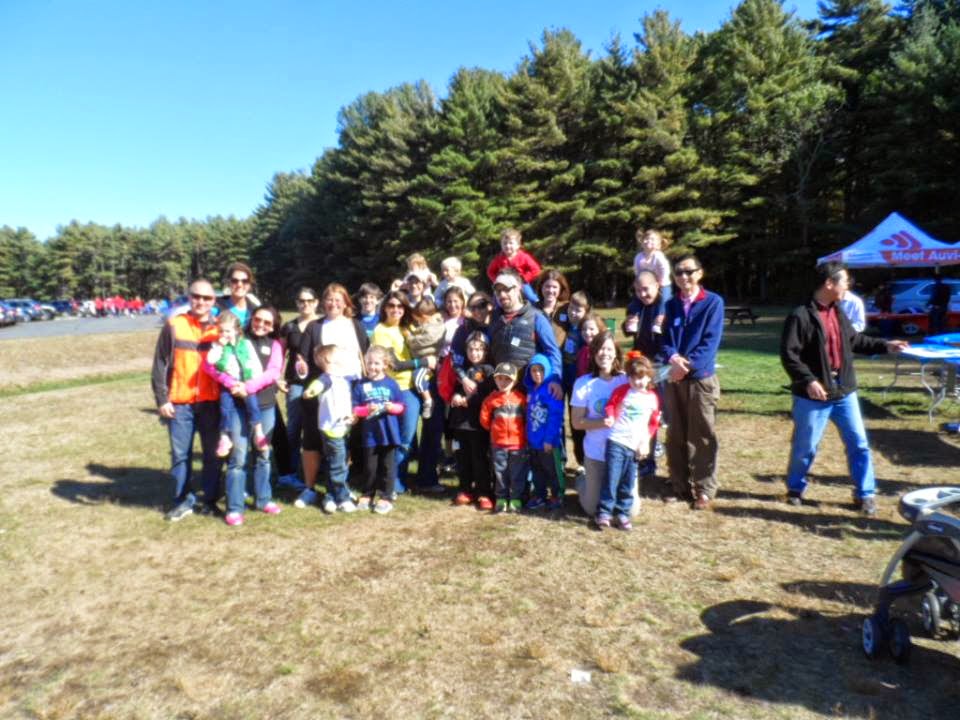
On October 5, 2014, we were honored to be among the exhibitors to have a booth at the FARE Walk in Boston.  Amanda LeFew, Co-Director of The FPIES Foundation, greeted families and raised awareness to Food Protein Induced Enterocolitis Syndrome, a different type of Food Allergy. FPIES Foundation Volunteer, Victoria Warren, Emceed the event and Medical Advisory Board Members Dr. Lee, Dr.Yuan, and Dr. Shreffler were in attendance and met up with a large group of FPIES Families!


October 11, 2014, The FPIES Foundation participated in The FASGMN Food Allergy Resource Fair for the 4th year. Joy Meyer, Co-Director of The FPIES Foundation was on hand to raise awareness to FPIES, and included providing CheeCha Puff samples, donated by our partners at CheeCha puffs!


The FPIES Foundation is committed to building awareness, education and support to families affected by Food Protein Induced Enterocolitis Syndrome, our shoes may be small but our steps will be big! We wrapped up this season of awareness by participating as an exhibitor in the NASPGHAN conference in Atlanta! Truly, a big step--- the FPIES Foundation was the first FPIES advocacy non-profit organization to participate in this esteemed National Pediatric GI conference! Watch for future posts about details regarding this successful event!

This post was written by the Executive Board of The FPIES Foundation